
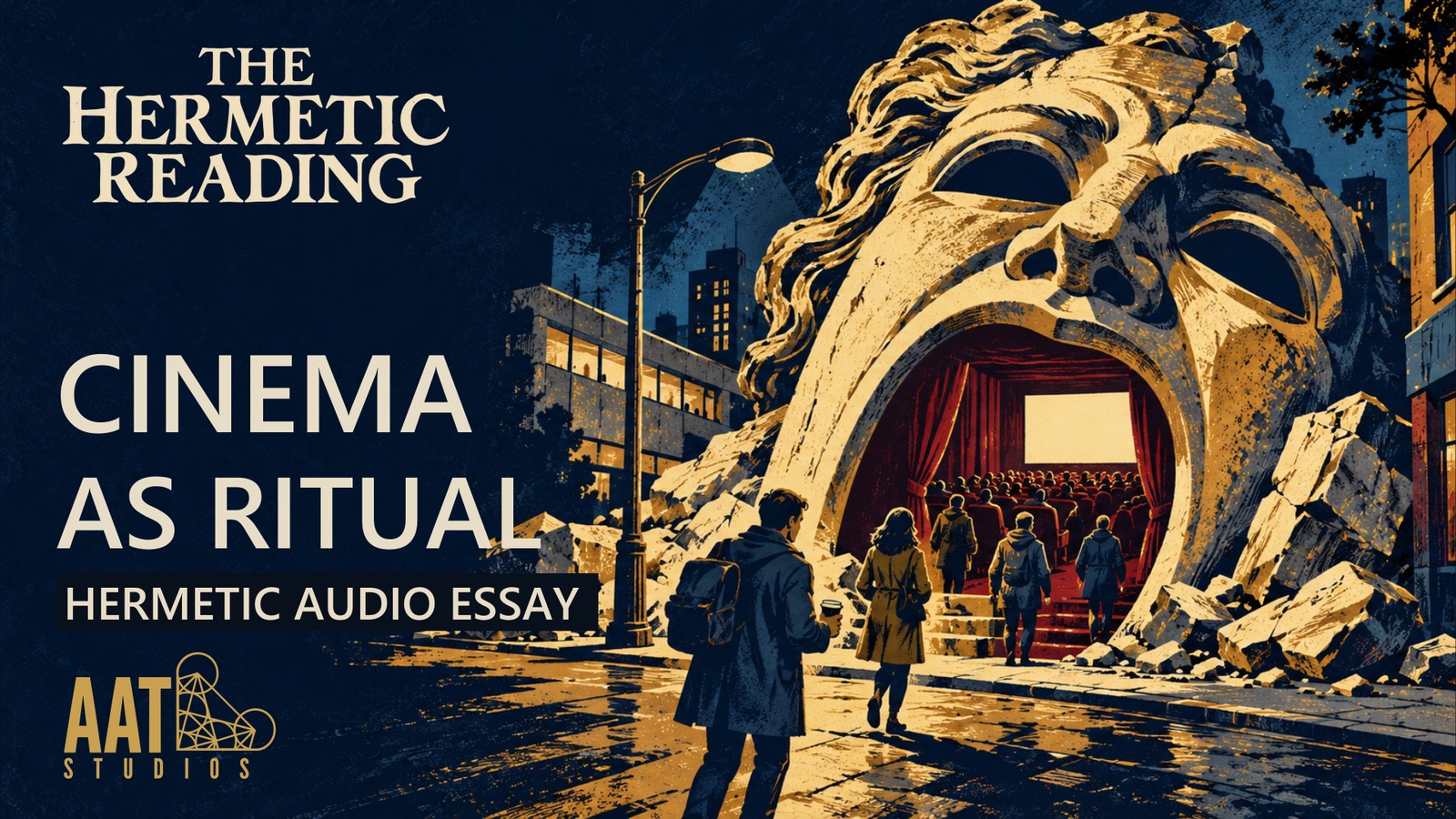
A Thursday night in a suburban multiplex. The eleven o'clock screening of whatever has been engineered this year to be the film everyone must see in the first weekend. I am sitting in the back row because you can watch them better from there than from the middle. The lights go down. Two hundred faces go slack at the same instant. Two hundred nervous systems hand over their somatic awareness to the screen and do not get it back for two hours and twenty-seven minutes. When it ends and the lights come up again I watch them come out of it, one by one, in the way people come out of general anaesthesia: the slow blinking, the hand passing across the face, the small involuntary noise — a laugh, a sigh, a wet exhale — that marks the moment the soul re-enters the body.
A young couple a few rows ahead of me sit unmoving for a full minute after the credits have ended. She is crying without knowing she is crying. He has his mouth slightly open in the way a child does when something has happened to him he does not have the words for. Neither of them has said anything. Neither of them will say anything, I can tell, until they are outside in the parking lot and have negotiated the re-entry into the shared consensual fiction that they are ordinary adults who have just been to a movie.
They were not at a movie. Nobody is ever at a movie. That is a polite name for what happens in this room. The polite name was put on it a hundred years ago by people who needed the general population to keep showing up without asking what the price of the ticket was actually buying.
What they just did, that couple, was go to church.
The church did what churches have always done. It gathered them, in a chamber designed for the purpose. It darkened the chamber to dissolve their ordinary sense of self. It piloted their emotional state for the duration of the ceremony with sound, image, narrative pacing, and the carefully calibrated release and withholding of information. It showed them archetypal figures performing an archetypal story. It moved them through fear, through grief, through exaltation, through recognition. At the end it released them, subtly altered, into the parking lot, where they will spend the next several weeks slowly metabolising what was installed in them, without ever identifying what happened as an installation.
The ticket was twenty-two dollars. The tithe has kept pace with inflation. The liturgy is in English now and the sanctuary has better carpet. Nothing else has changed.
Let me tell you the thing the modern world most does not want you to know about itself, because once you have seen it you cannot unsee it and the whole apparatus becomes visible at once.
Every civilisation in human history has had a ritual apparatus. No civilisation has ever been without one. No civilisation has ever been capable of being without one, because the human nervous system is constructed such that it requires certain operations at regular intervals and will acquire them somewhere, whether the society provides them on purpose or not.
The anthropologists have known this for a hundred and fifty years and have been curiously unable to say so in language a layman can follow, which I suspect is not accidental. Durkheim saw it at the end of the nineteenth century and gave it the name collective effervescence — the state a human group enters during ritual, in which individual identity dissolves into group identity and a charge builds that reshapes the participants when they return to ordinary consciousness. Victor Turner described the structure: separation from ordinary life, the threshold state of liminality in which the ordinary rules are suspended, the re-incorporation into the community with a new status. Mircea Eliade described the function: the periodic reconnection of profane time to sacred time, without which the community's grip on meaning decays and the society loses its capacity to act as itself. These are not fringe ideas. These are the foundational findings of the academic disciplines that studied how human beings have actually lived for most of history, and they are findings that the present ruling ideology has reason to obscure.
A ritual, operationally, does four things. It marks a threshold — birth, puberty, marriage, death, the change of seasons, the change of status. It discharges collective emotion that cannot be discharged individually — grief, terror, joy, the need to kill something. It renews the bonds that hold the group together, through shared physical presence and shared symbolic experience. And it installs meaning — it gives the participants an experience of the larger pattern inside which their individual lives make sense.
Without these functions performed, a human society does not cohere. The individuals in it experience the unprocessed version of what ritual would have processed. Grief that should have been discharged at a funeral does not go away; it metastasises inside the bereaved person as depression, as addiction, as the long low-grade despair of the bereaved in a civilisation that has lost its funerary competence. Fear that should have been discharged through the rites of passage does not go away; it metastasises as the chronic anxiety that is now pandemic among people who have not been through a single ritual of transition in their lives. The emotions do not cease because the rite has been withdrawn. They go somewhere, and the somewhere is either the individual body, where they make the person ill, or the collective body, where they make the civilisation sick. Everyone in the present West is either ill or is working hard to avoid noticing that they are.
Here is what I want you to sit with, before I go on. The church, for a thousand years, was the operative institution through which the West performed these functions. Say what you will about the Catholic Church — and I have much to say about it, and will, later — it did the work. It baptised the infants and married the couples and buried the dead. It gathered the community weekly in a chamber designed for the purpose, dissolved their ordinary consciousness with incense and Latin and the bodily postures of prayer, piloted their emotional state through the liturgical year, showed them archetypal figures performing the archetypal story, and discharged the collective energy through the ritual meal that was also, and this is no accident, a ritual consumption of the god. The peasant leaving Mass at eleven on a Sunday morning in 1450 had just done what the couple leaving the Thursday midnight screening had just done. The mechanics were identical. The content differed, and the content matters, and we will get to the content, but the mechanics were identical.
Then something happened to the church.
What happened to the church is a four-hundred-year story that I will compress into three paragraphs because you can research the long version yourself and because the long version is a distraction from the point.
The Reformation split the West religiously and destroyed the unity of the ritual apparatus. The Enlightenment then attacked the remaining fragments, on the grounds that ritual was irrational and the rational man did not need it. The Industrial Revolution dispersed the rural populations into the cities and severed them from the seasonal and agricultural rhythms that had been the scaffolding on which the ritual year was built. The twentieth century then did the finishing work: two world wars that destroyed the moral authority of the Christian nations that had produced them, a sexual revolution that dissolved the sacramental meaning of marriage, a counter-culture that completed the discrediting of the remaining rites, and a mass media environment that colonised the attention that would previously have been available for religious practice. By the year 2000, the church had been reduced, in the lived experience of most Western people under forty, to a quaint and occasional backdrop — the place you got married if you were old-fashioned, the place your grandmother was buried, the place politicians invoked on holidays. The functional ritual apparatus of the West had been dismantled piece by piece over four centuries.
The human need for ritual, however, had not been dismantled. It could not be. The dismantling would have required the modification of the human nervous system itself, and that project, although actively in progress, is not yet complete. The need remained. The need remained at the species-scale intensity it has always had. The only question was where the need would go.
Nature abhors a vacuum. So does the soul. In a civilisation that has destroyed its ritual apparatus, the ritual need will migrate to whatever fills the space. Whatever fills the space will then perform the ritual functions, whether or not the operators of the replacement apparatus know they are doing so, whether or not the participants know they are participating, whether or not the functions are performed for the good of the participants or for the good of the operators.
What filled the space is the subject of this essay. It filled the space at two speeds, in two waves. The first wave was the entertainment industry — Hollywood, the recording industry, professional sports, the tabloid press. The second wave was the digital platforms, which absorbed and scaled the first wave and added new ritual functions nobody had anticipated. The combined system is the most sophisticated ritual apparatus in human history, operated by people who deny they are operating a ritual apparatus, for ends they will not describe in public, on populations that have been trained from birth not to perceive what is happening to them.
Hollywood was the first temple to be built on the cleared ground, and it was built on purpose, by people who knew exactly what they were doing, between roughly 1910 and 1940. I am not going to tell you the history of the studio system. I am going to tell you what Hollywood is, structurally, as a ritual apparatus, because structurally is the only way to understand it.
The cinema auditorium is a temenos — a Greek word meaning a space set apart, consecrated by the fact of being set apart, inside which the rules of ordinary consciousness are suspended. The temenos has a boundary, crossed by the purchase of the ticket and the presentation of it at the door. Inside the boundary, you enter a chamber deliberately designed to disable your ordinary somatic and social awareness. The lights dim. The darkness forces your visual attention onto the screen, which is the only source of light. Your body, which you cannot see, begins to feel less solid. The sound is calibrated to come from all around you, which disables your spatial orientation. The seat is designed to immobilise you comfortably for the duration. You cannot easily see the faces of the other worshippers, which dissolves your social performance of yourself and allows you to feel emotions you would not have permitted yourself in a lit room among visible witnesses.
What is put before you, in this state of dissolved self, is the liturgy. The liturgy is carefully paced. It moves you, in sequence, through a calibrated set of emotional states — terror, tenderness, longing, exaltation, release — at the rate of one every ten or fifteen minutes for two hours. The pacing is done by experts who understand your nervous system better than you do. The music does half the work; you are not tracking the music consciously, which is how the music gets underneath the conscious mind and installs its emotional commands directly. The imagery does the other half. The archetypes on the screen are the old archetypes — the hero, the mother, the trickster, the threshold guardian, the shadow — because these are the figures to which the human unconscious is pre-wired to respond, and the operators of the apparatus know this with the certainty of a priesthood that has been refining its craft for a hundred years.
Then the liturgy concludes. You are released back into the parking lot, subtly altered. The thing that was installed in you begins its work. Over the next weeks, you find yourself thinking about the film, or a character from it, or a line from it, or — and this is the deepest effect — an attitude toward life that you acquired during the two hours and have taken as your own, without being able to say when you acquired it. You have been altered. The alteration was the purpose. The alteration was what the twenty-two dollars bought.
There is one more feature of this apparatus that the old temple did not have, and it is worth naming, because it marks the crucial difference. In the old temple, the liturgy pointed upward. It pointed to a story in which the human being was a creature inside a larger meaningful pattern — a pattern that had existed before him, that would exist after him, that included the dead and the unborn, that imposed obligations and offered grace. The peasant leaving Mass had been placed, for an hour, inside a cosmos that contextualised him. The liturgy of the new temple, in the overwhelming majority of cases, does not do this. It places the participant inside a cosmos in which he — or, more often, an idealised version of him — is the central figure, in which the obligations are unclear, in which the metaphysical horizon is either absent or replaced by various forms of technological transcendence. The participant leaves the cinema not placed inside a larger pattern but inflated within a smaller one. The old temple made the worshipper smaller and freer. The new temple makes the worshipper larger and more bound. The difference is not decorative. The difference is the entire purpose of the swap.
Now we come to the stars, and the stars are the hardest thing in this essay to see clearly, because the apparatus has trained you, from birth, to see them the way it wants you to see them.
Stars are not people. This is the sentence that, if you understand it, opens everything. Stars are not people. Stars are archetypal vessels, selected and constructed by the apparatus for the purpose of carrying specific archetypal charges in the collective imagination, for the duration for which the apparatus requires the charge to be carried. The person whose body the vessel is constructed on top of is not the star. The star is the construct — the composite of image, performance, manufactured biography, styled appearance, trained voice, and carefully-released biographical revelation — that has been assembled on top of the person, over years, by teams of professionals whose work you have been trained to ignore. The person is the substrate. The construct is the star. The public worships the construct. The person is a different matter entirely, and the gap between the person and the construct is the wound that kills most of the people who are made into stars, and this, too, is part of the design.
The archetypes cycle and recur. There has been, continuously for a hundred years, a Young Female Goddess in the apparatus — Marilyn, then Madonna, then Britney, then Taylor, then the next one they are already grooming. The names change. The archetypal position does not. There has been continuously a Tortured Male Genius — James Dean, Jim Morrison, Kurt Cobain, the current incumbent — who dies young, preferably violently, and whose death functions as a sacrifice that releases archetypal energy back into the apparatus. There has been continuously a Wise Elder, a Trickster, a Strong Woman, a Rebel, a Fool. Every archetypal slot is filled at all times. When the current occupant's body fails — through age, through death, through the destruction that being a vessel for archetypal energy over years does to the human substrate — the next occupant is installed, often before the previous one has exited the stage, so the public never notices that the role is a role.
I want you to think about that word, vessel, because it is the operative word. The star's function is to carry a charge. The charge is what the public wants from the archetypal position — the longing, the identification, the fantasy, the worship. The public cannot pour this charge onto an archetype directly; it needs a body to direct it at. The star's body receives the charge. This is why celebrities age visibly in ways ordinary people of the same age do not; it is why they develop the addictions and the eating disorders and the psychological disturbances they develop; it is why so many of them die young or die strangely or, if they do not die, live long lives of increasing withdrawal from the public eye. The human body was not constructed to be a vessel for archetypal charge poured onto it by millions of strangers over years. The body breaks. The breaking is structural, not incidental, and the apparatus anticipates it and replaces the broken vessel with a new one with efficiency the public does not notice.
There is a pattern, visible to anyone who will look at it, in the deaths of the most intensely-charged stars. The young ones die young — a precise subset of the overall star population, exactly the ones who carry the heaviest charges, the ones whose archetypal position is most central to the current stage of the apparatus. They die at twenty-seven with statistically implausible frequency. They die by overdose, by suicide, by accident, by means that are sometimes ambiguous. The official account treats each death as an individual tragedy, a private matter of depression or addiction or bad luck. The structural account, which I am giving you, is that the death of a young star is functional within the apparatus — it releases the archetypal charge back into the collective substrate, where it can be reinvested in the next vessel, and it converts the dead star into a permanent archetypal figure whose image will continue to operate in the collective unconscious for generations, carrying whatever the apparatus chooses to attach to it.
I am not telling you any specific named person was murdered. I do not know who was murdered and who was driven to the condition in which they ended their own lives and who simply broke under the weight of the charge. I am telling you the structure is the structure. The structure does not require specific murders to operate. The structure operates whether or not any given death was engineered, because the apparatus that manufactures the vessels and pours the charge onto them is the same apparatus whether the terminal event is an engineered one or a merely statistically-inevitable one. The operators do not need to kill every sacrificial vessel. The operators only need to manufacture the conditions under which the sacrificial death becomes likely, and then perform the resulting death as if it were a meaningful public event, and the archetypal function is performed. The structure is more efficient than individual murder. The structure is the murder, and the body is the byproduct.
You have been trained, by the apparatus itself, to treat this analysis as paranoia. The training is the deepest layer of the spell. Notice the training. The training is itself evidence.
Music is the second temple, and music is, in some ways, more important than film, because music bypasses the conscious mind more completely than film does and because music is repeated more often. A film you see once, maybe twice. A song you hear three hundred times. A song you hear three hundred times has been given three hundred opportunities to install its emotional and symbolic payload into your nervous system, at a depth beneath the conscious mind's capacity to review what is being installed.
The engineering of popular music as a social-control mechanism is not a theory. It is the documented work of a number of institutions over the course of the twentieth century, and the documentation is available to anyone who will read it. I am going to name three of the institutions, briefly, because the names matter, and then I am going to tell you what they were doing.
The Frankfurt School — Theodor Adorno and Max Horkheimer most famously — produced, in the 1940s, a body of work explicitly analysing popular music as a mass-psychological manipulation technology. Adorno's essay On the Fetish-Character in Music and the Regression of Listening (1938) and his later work in The Culture Industry described with considerable precision how mass-produced music conditions its listeners into passivity, standardised emotional responses, and the inability to distinguish authentic feeling from manufactured feeling. The Frankfurt School were Marxists and wrote as critics. Their analysis of the mechanism was, however, correct — and the people building the mechanism read their analysis and used it as a manual.
The Tavistock Institute of Human Relations in London — founded after the Second World War with funding from the Rockefeller Foundation — produced, over decades, studies on group psychology, mass persuasion, and the behavioural effects of popular culture on target populations. Tavistock's actual work is less sinister than the conspiracy literature claims and more sinister than the official accounts admit. They studied how to modify the behaviour of populations through the mass media, they were paid by governments and corporations to do so, and the techniques they developed were real and effective. The claim that they "engineered" the Beatles or the Rolling Stones is overstated in its popular form — these were commercial acts created by commercial processes — but the underlying observation, that the music of the 1960s was monitored, studied, and in some cases shaped by intelligence-connected institutions for its effects on the target populations, is accurate. Read the declassified files. Read the biographies of the music industry executives who also, in several well-documented cases, held intelligence-community relationships. The picture that emerges is not the one the official history tells.
The third institution is the one whose operations remain most opaque: the cluster of American intelligence programs, running from roughly 1947 onward under various names — MKULTRA, MKNAOMI, MKSEARCH, Operation Artichoke, Operation Paperclip on the recruitment side — whose mandate included the development and deployment of psychological manipulation techniques at population scale. The declassified MKULTRA files alone, released under FOIA in the 1970s after Congressional investigation, describe over 150 subprojects involving everything from LSD experimentation on unwitting American citizens to the development of behavioural conditioning protocols. Most of the files were destroyed on direct order before the investigation. What we have is the fragment that survived deletion. The fragment is damning. The destroyed whole was, presumably, more damning. The operations did not end when the programs were publicly terminated; the programs were renamed and continued under different funding lines, as declassified Senate testimony has subsequently made clear. The participation of the American music industry in the relevant decades — Laurel Canyon, the folk revival, the psychedelic wave, the engineered breakdown of the counterculture — has been documented at book length by several researchers whose work remains conspicuously unaddressed by the mainstream historical consensus. I am not going to recite their case. I am going to direct you to read it yourself. Start with Dave McGowan. Finish with whoever has picked up where he left off.
What the combined apparatus did, and continues to do, is this. It identifies social trends that could threaten the stability of the managed consensus — rebellion, ethnic consciousness, spiritual seeking, the discovery of uncomfortable historical truths. It then manufactures, within those trends, controlled figureheads — musicians, movements, scenes — that channel the energy of the rebellion into forms that are commercially extractable and politically neutralised. The authentic impulse is captured at the leading edge, commercialised, routed through industry infrastructure, and sold back to the population in a form that looks like the rebellion but no longer threatens anything. The 1960s counterculture, which began as a genuine spiritual and political awakening among American youth, was captured within five years and converted into the commodity form of rock music, drug culture as consumer segment, and a politics of personal expression that replaced the politics of structural change. The 1990s grunge movement, which began as a genuine regional artistic response to the Reagan-Bush decade, was captured within three years and converted into the commodity form that sold hundreds of millions of records while its originators destroyed themselves under the archetypal pressure the apparatus had poured onto them. The pattern repeats in every decade. The only thing that changes is the speed of the capture and the efficiency of the subsequent monetisation.
The music of the present age is engineered more precisely than the music of any previous age. The beats per minute are optimised for the physiological responses of the target demographic. The lyrical content is tested against focus groups and adjusted for maximum retention. The melodic hooks are generated, in many cases, by algorithmic systems that have learned what reliably captures the adolescent nervous system. The artist, where the artist exists at all as a creative entity rather than as a vessel for the pre-existing material, is a hired face for a product that was largely finished before the face was attached to it. The fact that this is common knowledge in the industry and a matter of active denial in the public press tells you everything you need to know about whose interests are served by which narrative. Musicians who depart from the script are dealt with. The ones who are commercially valuable enough to retain are managed. The ones who are not are disposed of through the various mechanisms — financial destruction, public humiliation, the well-timed scandal, the convenient tragedy — that the apparatus has at its disposal.
I am telling you, plainly: the music you grew up on was not what you thought it was. The artists were not, in most cases, the self-determining creative geniuses the hagiographies describe. The movements were not, in most cases, the organic cultural eruptions the retrospective documentaries present. The sound of your generation was shaped, deliberately, by institutions with objectives you were not consulted about, and the shaping of that sound shaped you. The person you are today — your nostalgias, your emotional reflexes, your political intuitions, the texture of your inner life — was formed, in significant part, inside a ritual apparatus whose priests you never met and whose liturgy you never consented to.
I have used the phrase predictive programming once already in this corpus and I want to spend a little more time on it here, because it is one of the operative techniques of the apparatus and the mechanism is specific and worth describing cleanly.
Predictive programming is the practice of depicting future events in fictional media, usually years in advance, such that when the events occur the target population receives them as already-familiar, already-processed, already-grieved. The prior depiction of the event in fiction does the pre-processing work; by the time the event arrives in the real world, the emotional response has already been channelled along the lines the fiction laid down, the acceptable political responses have already been modelled, and the capacity for genuine shocked refusal has been used up in advance.
The mechanism works because of a feature of the human imagination that the apparatus understands and the general population does not. The imagination does not distinguish, at the deepest level, between events it has seen happen in fiction and events it has seen happen in life. The emotional imprint of a vividly depicted fictional event is, at the level of the unconscious, nearly identical to the emotional imprint of an actually-witnessed event. This is why you can cry at a film about characters who never existed. This is why you can carry a traumatic imprint from a film you saw at the wrong age for decades. This is why the apparatus, having understood this feature, weaponised it.
I will give you one example and leave the rest for your own research. The destruction of the Twin Towers on the 11th of September, 2001, was depicted in American popular culture, in various forms, for at least two decades prior to the event. The towers appear as targets of destruction in films, in comics, in television episodes, in promotional materials, with a frequency that exceeds any statistical explanation. I am not telling you this proves any particular theory of the event itself. I am telling you that when the event occurred, the American population received it as already-known, which is one of the specific operative effects the predictive-programming technique is designed to produce. The response to the event was shaped, in advance, by the cultural material the population had been marinating in for twenty years. The specific political and emotional responses that did in fact follow — the fear, the patriotic consolidation, the legislative acquiescence, the foreign wars — were available as responses in part because the population had been pre-fitted with the emotional infrastructure to respond that way, by the media they had been consuming.
The same mechanism has been observable in the lead-up to every major civilisational event of the last thirty years. Watch the films that are released in the three to five years before an event. Note the themes. Note the specific imagery. Note, afterwards, which of the themes and images recur in the event's actual unfolding. You will see the pattern, once you begin to look for it. The pattern is so consistent that the most defensible explanations are, in descending order of politeness: the operators of the apparatus brief the script-writers; the script-writers and the operators draw from the same intelligence briefings; the symbolic layer of reality communicates the coming events to sensitive perceivers who then encode them in their work; or some combination of all three. I incline toward the combination. You may take the explanation that suits your metaphysics.
The news cycle is the third limb of the apparatus, and the news cycle is the one most denied its ritual character, because the news purports to be a neutral description of events whereas film and music concede their artifice. The news is not neutral. The news has never been neutral. The news is a daily ritual of archetypal activation, performed by a priesthood that has been professionally trained to perform it and that is now selected, trained, and promoted on the basis of its willingness to perform it.
The mechanism is simple and worth describing. Every morning, the priesthood identifies which archetypal positions will be activated that day in the collective imagination. The archetype of the innocent victim. The archetype of the menacing other. The archetype of the heroic leader. The archetype of the shameful class that must be punished. The archetype of the approaching catastrophe that only the experts can manage. The day's events are then selected from the very large field of things that actually happened, edited, framed, and presented in such a way that they activate the chosen archetypes in the audience. The audience, which has been trained for decades to receive the news as a factual account of what matters, does not perceive the selection. It does not perceive the archetypal activation. It perceives, simply, that these are the things that are happening today and that they are happening in this way. The archetype is installed. The emotion is discharged. The political consequence follows.
Notice how the emotions cycle. A week of grief over a specific disaster. A week of outrage over a specific villain. A week of hope around a specific announcement. A week of fear of a specific threat. The cycles are approximately weekly because the nervous system needs approximately a week to discharge and refill for the next cycle, and the apparatus has calibrated its cadence accordingly. Notice how the specific disasters and villains and announcements and threats are forgotten, almost completely, within three months of their news cycle ending. You cannot remember what last June's crisis was. It has been overwritten by the subsequent crises. The content is not the point. The cycling of the emotions is the point, because the cycling is how the apparatus keeps the population in the continuous agitated state required for it to remain controllable.
A person who is continuously agitated is a person who cannot concentrate for long enough to form his own views, cannot sit in silence for long enough to hear his own interior, cannot step back for long enough to see the pattern. This is not an accidental side effect of the news cycle. This is the operative purpose of the news cycle. The pattern has been noted, by internal critics within the industry, for decades. It continues because it serves those whom it serves.
I am not telling you to stop reading the news. I am telling you to read the news the way an anthropologist reads the rites of a foreign tribe — with attention to what the rite is doing to the participants, not to the content the rite is using as its cover. Once you read it that way, the news becomes legible. You will see, in any given day's coverage, which archetypes are being activated, which emotions are being cycled, which populations are being prepared for which political consequences. You will cease to be a participant in the ritual. You will become an observer of it. The observation, performed daily over time, is itself one of the most powerful disciplines available for the work we began in Liber Primus.
There is a fourth limb of the apparatus that most commentators miss, because its content is the most transparently escapist, and the escapist form disguises the ritual function. Professional sports. The Super Bowl is the most-watched event of the American year. It is, structurally, a ritual — the archetypal combat of two tribes, staged within a consecrated ground, at a fixed date on the calendar, attended by a national assembly either in person or through the continuous simulcast that converts the whole country, for four hours, into a single synchronised ritual body. The halftime show is the liturgy inside the liturgy — an explicit performance, on the largest stage in the ritual year, by the highest-charged archetypal vessel the apparatus can deploy, in front of the largest collective audience the civilisation assembles. The symbolism deployed at halftime is not coded by accident. Watch the halftime shows of the last ten years in sequence. Note the recurring imagery — the pyramids, the pillars, the masks, the choreographies that reproduce older initiatic rites in modernised costume. Note the moment, in several of them, when the central performer undergoes a visible ritual transformation, often one involving fire or water or ascent. The symbolism is not being put there for decoration. It is being put there because the ritual function of the performance requires the archetypal imagery and because the operators of the apparatus know exactly what imagery they are deploying and for what effect.
I am not going to tell you every halftime show is a Luciferian initiation rite. I am going to tell you that the imagery of Luciferian initiation rites is consistently present in the halftime shows, and that the people designing the halftime shows are aware of the tradition they are drawing from, and that the hundred and fifty million Americans sitting in front of their televisions receiving the imagery are not aware of what they are receiving. That asymmetry is the operation. The asymmetry is the point. If the audience understood what was being performed on them, the performance would not work. The work depends on the audience's innocence of its own ritual participation. The work depends on the audience's continued belief that it is merely watching a football game.
We come now to the darkest limb of the apparatus, which is pornography, and I am going to speak about it directly because it is the operation whose mechanism is least understood and whose effects on the population are most catastrophic and least discussed.
What you have been told about pornography — that it is entertainment, that it is a private matter, that the only objections to it are religious or prudish — is the cover story. The cover story was written by the industry that profits from it and has been enforced, over decades, by a remarkably co-ordinated set of media and political actors. The cover story is false. Pornography is not entertainment. Pornography is, in the precise and operative sense, black magic — the systematic inversion of a sacred current into its mirror image, for purposes that benefit the operator of the inversion at the expense of the participant.
Let me tell you what sexual energy is, in the Hermetic understanding, because this is the understanding the operators of the inversion are working with, even when they do not name it in public. Sexual energy is the most concentrated form of creative-generative energy present in the human body. It is the energy that produces new life. It is, in the traditional teachings of every functioning mystery school on Earth, the energy that, when turned inward and upward rather than outward and downward, produces the transformation of the ordinary human into the awakened one. The Tantric tradition is about this. The alchemical tradition is about this. The Taoist internal alchemy is about this. The Kabbalistic teachings on Yesod are about this. The Christian mystical tradition, in its less sanitised forms, is about this. The energy is the most valuable substance the human body produces. The person who learns to conserve, transmute, and direct it is capable of operations that are not available to the person who dissipates it. This is not metaphor. This is operative reality, known to every initiated tradition, suppressed from the public understanding of the modern West for specific reasons.
Pornography, as an industry, performs the following operation on the population. It hijacks the sexual attention of the individual and directs it at an image. The image is, by definition, not the individual's actual sexual partner. The energy, which would have been directed at a real human being in a real embodied encounter — with all the developmental consequences that real encounter would have had — is instead directed at a manufactured image, which cannot return the energy, which cannot complete the circuit, and which extracts the energy from the participant's system without giving anything back. The dissipation is the point. The extraction is the point. The leaving of the participant in a slightly-depleted state, slightly-more-addicted-to-the-image, slightly-more-incapable-of-directed-real-world-intimacy, is the point.
The operation is performed on a population now measured in the hundreds of millions, daily, at scale. The aggregate effect — the accumulated depletion of the sexual and creative energy of an entire civilisation, over decades, in service of an industry that has, structurally, no other function than to perform the depletion — is one of the largest magical operations in human history, and it is being performed almost entirely without the awareness of those on whom it is being performed. The industry denies it is performing a magical operation. The industry is correct in the narrow sense that the operators of the industry, most of them, do not consciously understand that what they are doing is a magical operation. The operation is performed regardless of the operators' understanding, because the operation is structural to the medium.
The effects on the population are visible if you know where to look. Rates of male infertility have been declining for decades in every industrialised country measured. Rates of sexual dissatisfaction within long-term relationships have risen. Rates of young men unable to form the kind of sustained attention-to-a-real-person that a committed relationship requires have risen. The average age of first sexual encounter has been rising, while the age of first pornography exposure has been falling and is now, in most developed countries, pre-adolescent. An entire generation of men have had their initial sexual imprinting performed by a manufactured image rather than by a living person, and the consequences for their subsequent capacity for real intimacy are not being discussed in the public press because the industry that profits from this state of affairs also substantially controls the public press.
I am telling you this is one of the operative spells of the present age and that almost no one in your social environment has the vocabulary to describe what has been done to them. You have the vocabulary now. Use it.
I want to pull all of the above together by naming, explicitly, the structural principle that runs through it, because the principle is the same one I named briefly in Liber Primus and whose operation I want you to see with more precision now.
The principle is inversion. The Adversary, in the operative sense in which the modern apparatus is the Adversary's apparatus, does not work by simple opposition. Simple opposition would be visible and rejectable. The Adversary works by running the real current backwards through its own infrastructure, so that every authentic spiritual need is met with a counterfeit that partially satisfies and permanently corrupts.
The human need for ritual is real. The Adversary supplies Hollywood and the news cycle. The ritual is performed. The participants are partially satisfied. The satisfaction extracts from them exactly the energy that would have gone into the authentic ritual and leaves them incrementally worse off with each iteration, so that the hunger for ritual, rather than being fed, grows.
The human need for sacrament — for a consecrated material object that mediates between the ordinary and the sacred — is real. The Adversary supplies the consumer good, the brand identity, the limited edition, the status item. The need is met. The meeting is counterfeit. The human carries his shopping bags home from the mall with some version of the feeling his great-great-grandfather had walking home from the cathedral, and he does not know the feeling has been hijacked.
The human need for communion — for the shared meal, the shared song, the shared presence — is real. The Adversary supplies the restaurant with the shared phone screen, the concert where every person films instead of attending, the sporting event where the crowd's unity is entirely channelled through and managed by the apparatus. The participants go home having communed with something, but the thing they have communed with is not each other. It is the apparatus itself. The apparatus has inserted itself into the role that would, in a healthy civilisation, be played by the community directly.
The human need for a story that makes sense of his life, his death, his suffering, and his responsibility is real. The Adversary supplies the political identity, the professional identity, the therapeutic narrative, the endless content feed. The participant is supplied with a story, several stories, any number of stories — but none of the stories will bear any weight, because none of them are true. The human dies, in the modern West, in the condition of never having had a story about his life that he actually believed. The Adversary has been satisfied. The human has been wasted.
The human need for sexual union — union in the full sense, including the spiritual and generative senses — is real. The Adversary supplies pornography. The need is met. The meeting is an inversion. The spiritual function that sexual union performs, in traditional understanding, is not merely un-performed; it is actively reversed, so that the energy that would have produced an awakening in the participant instead produces a depletion.
The human need for initiation — the marked transition from one developmental stage to another, under the supervision of elders who have made the transition themselves — is real. The Adversary supplies the school system, the college fraternity hazing ritual, the corporate onboarding, the branded coming-of-age experience. The participant receives something that has the shape of initiation — threshold, ordeal, return — but that does not perform the function of initiation, which is to kill the previous self and to install the next one under the authority of the tradition. What is installed in the modern initiation is, instead, loyalty to the system that performed the pseudo-initiation. The young person leaves his fraternity or his corporate onboarding marked not as an adult but as a lifelong member of the institution that processed him.
In every case the mechanism is the same. The authentic spiritual current runs in one direction. The Adversary builds its infrastructure along the same pathways, in the same archetypal positions, using the same aesthetic forms, and runs the current backwards. The participant, who cannot easily distinguish the true direction from the false because he has never seen the true direction in operation, believes he is being fed, when in fact he is being drained. Over a lifetime of this, the human becomes the creature we see around us now: a man or a woman whose every authentic need has been met by a counterfeit, whose every ritual has been performed by an apparatus with objectives not his own, whose every spiritual opening has been used as a point of extraction. The creature is recognisable. You can see him in the Target parking lot I described at the beginning of the prior essay. You can see her in the multiplex I described at the beginning of this one. You may be able to see him or her, if the light is right, in the mirror.
The practices from Liber Primus apply here with specific intensification. I will not re-state them. I will tell you the specific forms they take against the ritual apparatus we have just been discussing.
Against the cinema apparatus: you do not need to never go to films again. You need to go to films rarely, and to go to them consciously — aware of what the room is designed to do to you, aware of the pacing of the liturgy, aware of the archetypal positions you are being invited to identify with, aware of what you are being asked to feel and when. The practice is not abstention. The practice is conscious participation, which is the opposite of unconscious participation, and which is extremely rare in the modern audience. You will find, after some months of this practice, that the number of films you want to see drops dramatically, because most of them are not, viewed consciously, worth the time. This is information. Act on it.
Against the music apparatus: build a small corpus of music you know, chosen carefully, that you return to over years. Do not let the algorithm choose your music for you. Do not consume the top-of-the-charts output unless you have decided, consciously, to study what is being deployed against the current adolescent nervous system. Listen to the dead. Listen to pre-industrial music. Listen to music from traditions whose aesthetic logic is not the aesthetic logic of the apparatus. Learn, if you can, to play an instrument — even badly — because the experience of producing music from your own body is the inoculation against the experience of having music produced onto your body by strangers.
Against the news apparatus: read the news as an anthropologist reads the rites of a foreign tribe. Once a day, for fifteen minutes, with full attention to what is being activated in you and why. Do not let the news run in the background. Do not let the news into the bedroom. Do not let the news be the last thing you metabolise before sleep or the first thing you metabolise on waking. The nervous system's permeability is greatest at those two thresholds. The apparatus knows this. Do not give the apparatus those two windows.
Against the celebrity apparatus: cease to track the lives of people you do not know. Their births, their couplings, their breakups, their deaths, their political statements, their fashion choices — none of this is for you. All of it is a hijacking of the attention you would otherwise have spent on the actual people in your actual life. Notice, over a month of practising the withdrawal, how much attention becomes available to be redirected to your own wife, your own children, your own friends. The redirection is one of the single most valuable returns on practice available to the modern person, and it is available for free to anyone willing to close the app.
Against the pornography apparatus: I am not going to give you a formula, because the formula is obvious and you have been told the formula already by every functioning spiritual tradition in history. I will tell you the direction. The direction is toward embodied intimacy with a real person, or toward the conservation and inward-and-upward transmutation of the energy the apparatus currently extracts from you. The direction is not toward less pornography consumption alone; the direction is toward the reconstruction of a sexual life oriented at something other than the screen. The reconstruction is long. It is possible. Others have done it. You can do it. The first year is the hardest. The rest of your life is what is on the other side of the first year.
Against the sports apparatus: watch less. If you watch, watch consciously, aware of what the ritual is performing. Do not let the halftime show reach the inside of your attention unmediated; if you are going to watch it, watch it with the commentary running of an adult who can see the symbolism for what it is. Take your sons out of the apparatus as much as you can while they are young. Play the actual game with them in the actual yard, which performs the archetypal function the televised game only simulates, and whose benefits go to the participants rather than to the apparatus.
The common move across all of these is substitution. You cannot evict a large existing practice from your life through pure negation. The vacuum will be filled by the next thing the apparatus offers. You have to replace the practice with another practice — the authentic version of what the false version was counterfeiting. This is the work. This is why it is not easy. This is why most people will not do it. This is why the people who do it become, over years, the unpossessed.
The work of Liber Primus was to show you the system. The work of this essay has been to show you the apparatus. The work of Liber Tertius, which comes next, will be to show you the operators — the specific men and institutions who, in the present age, are running the apparatus toward the eschaton I named in the opening volume. The essay after that will show you what they have been building and what they intend to do with it. The essay after that will show you the tradition they are drawing from and the tradition they are inverting. The corpus proceeds.
You are still welcome to close the book. The offer remains open. Every essay in this corpus is, structurally, a door you can walk out of, and I will not be insulted if you do. The work is not for everyone. The work is for those whose interior has already begun to signal to them that something is wrong, and who are looking for the vocabulary and the framework within which the wrongness can be named.
If you are still reading, I take that as your consent to proceed. I will proceed accordingly.
Before I close, one more thing — a thing I want to say here because it belongs in this essay rather than the next.
Everything I have described in the preceding pages is real, and the effect of seeing it is, for most people, a kind of grief. The grief is for the life you would have lived in a civilisation that had not been hollowed out. The grief is for the rituals you should have been given and were not. The grief is for the initiations you should have received and did not. The grief is for the communion with your own community that should have been the basic fabric of your life and that has been replaced, over the decades of your formation, by the apparatus's simulacrum of communion. The grief is appropriate. The grief is, in fact, the first functional emotion I have asked you to feel in this corpus, because grief is the emotion that accompanies the recognition of a real loss, and the recognition of a real loss is the first movement of the authentic life.
Do not rush through the grief. Do not attempt to reason your way around it. Do not, above all, try to fix it by consuming more content that describes the grief. Sit with it. The apparatus will try to pull you back into its circuits; resist the pull, for as long as you can, and let the grief do its work.
On the other side of the grief is something better than the life you had before, and I am not going to tell you what it is, because the telling would cheapen it and because the discovery has to be made by you and not by me on your behalf. Some things cannot be passed along in a book. Some things have to be found.
I will meet you in the next essay. Bring what the grief leaves behind.
The temple is gone. The liturgy continues. Learn to read it. It is the only way out.
Vale, frater. Vale, soror. The work is yours.